
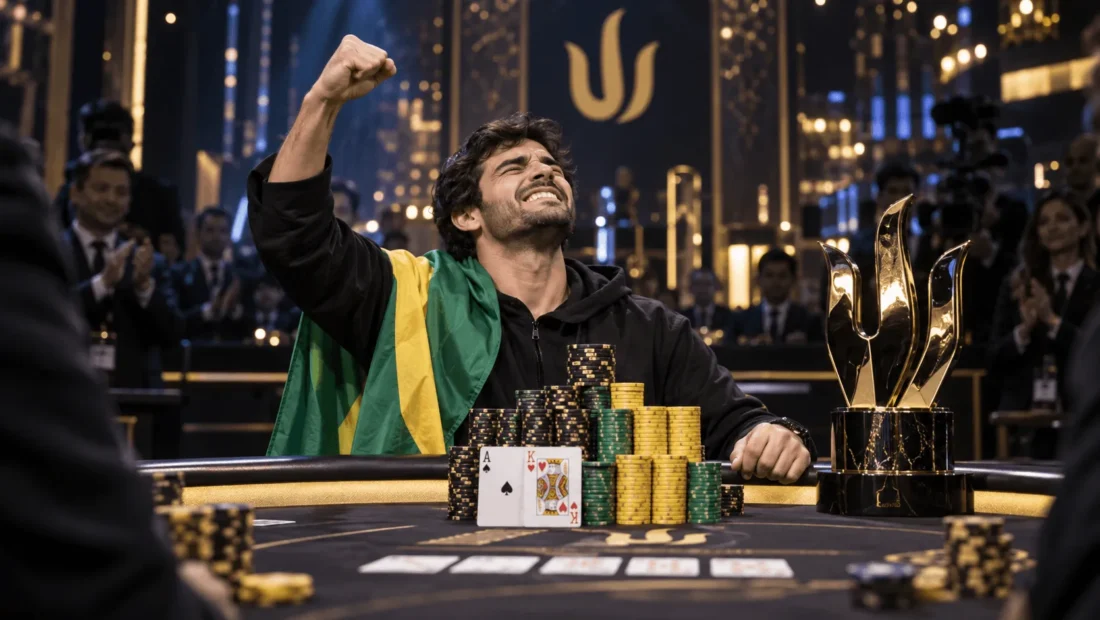
Joao Simao has won the biggest prize of his tournament career after completing a dramatic comeback to capture the $200,000 Triton Invitational at the Triton Super High Roller Series Jeju II. The Brazilian entered the record books with a $7,250,000 first prize, the largest tournament cash ever recorded by a Brazilian player, after surviving a field of 173 entries and a final table that represented eight different countries.
The event generated a $34,600,000 prize pool, setting a new benchmark for the Invitational format. Simao’s path to the title was made even more striking by the fact that he had been reduced to just two big blinds before recovering. Three days after the tournament began, he was the last player standing, defeating China’s Biao Ding after an extended heads-up contest in which neither player agreed to a deal.
A Record Event Produces a Record Brazilian Score
The size of the Invitational was extraordinary even by Triton standards. A $200,000 buy-in and 173 entries created a $34.6 million prize pool, turning the final table into one of the most valuable closing stages on the high-roller calendar. Simao’s $7.25 million payout was not simply his largest score. According to the source, it became the largest amount ever won by a Brazilian player in tournament poker.
That distinction adds another layer to a victory that was already significant. Simao had won a Triton title before, taking down the $150,000 event at the previous year’s WSOP Paradise. That tournament was notable because the top three finishers were all Brazilian. Jeju was very different. The final table brought together players from eight countries, and Simao had to beat a field that was international from top to bottom.
His reaction after the win reflected the scale of the moment. Simao described the experience as unreal and said it felt like the kind of thing that happens once in a lifetime. The numbers support that emotion. A second Triton trophy, a career-best cash and a national tournament record all arrived in the same result.
From Two Big Blinds to the Trophy
The headline detail of Simao’s run is the recovery from two big blinds. The supplied report does not provide a hand-by-hand account of the comeback, so the exact sequence cannot be reconstructed from the source. What can be said is that reaching such a short stack in a $200,000 event normally leaves a player with very little room for error, and Simao was able to survive long enough to rebuild and ultimately win.
That transformation is one reason the victory stands out beyond the size of the prize. High-roller tournaments often turn on a small number of all-in confrontations, and a two-big-blind stack offers almost no freedom to wait for ideal conditions. Simao’s eventual position at the top of the payout table therefore represents a complete reversal from the point at which his tournament life was most fragile.
The comeback also gives the result a different character from a wire-to-wire victory. Simao did not simply accumulate a large stack early and protect it. He had to recover from near elimination and then navigate a final table packed with experienced high-stakes players. The source does not overstate the mechanics of that comeback, and neither should the rewrite, but the two-big-blind low point is enough to show why the win was so memorable.
Biao Ding Pushes Simao Through a Long Heads-Up Battle
Simao’s final opponent was Biao Ding, the leader of China’s all-time money list according to the source. Ding finished second for $4,940,000, which was also a new career-high score for him. The two players chose not to make a deal, leaving the full difference between first and second place to be decided at the table.
That decision made the heads-up phase especially valuable. The gap between $7.25 million and $4.94 million is more than $2 million, so the final duel carried a financial weight larger than the first prize in many major tournaments. The source describes the battle as long and back-and-forth, suggesting that neither player was able to close it quickly.
Ding’s runner-up finish remains an enormous result even without the title. A career-best $4.94 million score from one of the strongest fields of the year would normally dominate the story. It was overshadowed only because Simao’s win combined an even larger payout with the comeback narrative and the Brazilian record.
Seth Davies Sets a Triton Invitational Record of His Own
Third place went to Seth Davies of the United States, who collected $3,470,000. His result also came with a record: Davies became the first player to reach three Triton Invitational final tables.
That achievement is different from Simao’s but still significant. The Invitational brings together elite professionals and wealthy recreational or business players in one of Triton’s most distinctive formats. Reaching one final table is difficult. Doing it three times demonstrates sustained success in an event that carries enormous buy-ins and consistently strong fields.
Davies did not win the tournament, but the $3.47 million payout and the final-table record ensure that his Jeju performance is part of the event’s history. In a tournament where several players set personal or national milestones, his third-place finish adds another layer to the list of records produced by the week.
Final Table Payouts Show the Scale of the Invitational
The money available at the final table illustrates just how large the tournament became. Every finalist earned at least $749,000, and the top seven all collected more than $1 million. Four players earned at least $2.82 million.
The top nine finished as follows:
| Place | Player | Country | Prize |
| 1 | Joao Simao | Brazil | $7,250,000 |
| 2 | Biao Ding | China | $4,940,000 |
| 3 | Seth Davies | United States | $3,470,000 |
| 4 | Yang Wang | China | $2,820,000 |
| 5 | Emilien Pitavy | France | $2,245,000 |
| 6 | Winfred Yu | Hong Kong | $1,693,000 |
| 7 | Hannes Jeschka | Germany | $1,237,000 |
| 8 | Thomas Boivin | Belgium | $905,000 |
| 9 | Eric Tsai | Taiwan | $749,000 |
The geographic spread is just as striking as the payout column. Brazil, China, the United States, France, Hong Kong, Germany, Belgium and Taiwan were all represented, with China having two players among the final nine. That international mix is a sharp contrast with Simao’s first Triton victory, where the top three positions were occupied by Brazilians.
The decision by Simao and Ding to continue without a deal also kept the published payout structure fully intact at the top. First place remained worth $7.25 million and second $4.94 million, so the heads-up match was not simply about the trophy. It determined a difference of more than $2.3 million between the final two payouts. That adds context to the source’s description of a long, back-and-forth duel. Even after both players had already secured career-defining money, there was still an enormous amount left to decide through play rather than negotiation. For Simao, closing that final stage turned an already extraordinary recovery into a record Brazilian score; for Ding, runner-up still produced the largest cash of his career.
Simao’s Second Triton Title Changes the Shape of His Resume
A second title is important because it moves Simao beyond the category of a player with one exceptional Triton result. His earlier victory at WSOP Paradise had already established that he could win at this level. Jeju confirms that the first title was not an isolated peak, and it does so in a tournament with a much larger first prize.
The difference in circumstances also matters. The previous win came in a final three dominated by Brazilian players, a remarkable national moment. The Jeju Invitational required Simao to navigate a far more internationally varied final table and then defeat one of China’s most accomplished tournament earners heads-up. The result therefore adds range as well as money to his Triton record.
It also raises the scale of his career dramatically. The source does not provide Simao’s full lifetime earnings total, so there is no need to speculate about where the new result places him on broader all-time lists. The facts already supplied are enough: $7.25 million is his largest score, the largest Brazilian tournament score and the prize attached to his second Triton victory.
Jeju II Delivers an Invitational for the Record Books
The event itself will be remembered for more than the winner. A 173-entry field in a $200,000 tournament is a statement about the size of the high-roller ecosystem around Triton. The $34.6 million prize pool gave the Invitational a scale that few poker tournaments can match.
The distribution of money across the final table also produced multiple personal bests. Ding earned the largest score of his career. Davies set an Invitational final-table record. Simao established a Brazilian tournament record. The remaining finalists received payouts ranging from $749,000 to $2.82 million, making the final table life-changing even before the title was decided.
For Simao, though, the defining image is the journey from two big blinds to first place. Tournament poker is full of comebacks, but they rarely end with a $7.25 million prize. The combination of survival, recovery, a no-deal heads-up match and a record field turned Jeju into the biggest result of his career.
The Brazilian now leaves Jeju with two Triton trophies and a place in the record books that goes beyond simply winning one event. His first Triton title was memorable for the Brazilian sweep around him. His second was bigger, more international and more dramatic. In a tournament designed to bring together the highest end of the poker world, Simao finished with the last stack and the largest cheque.