
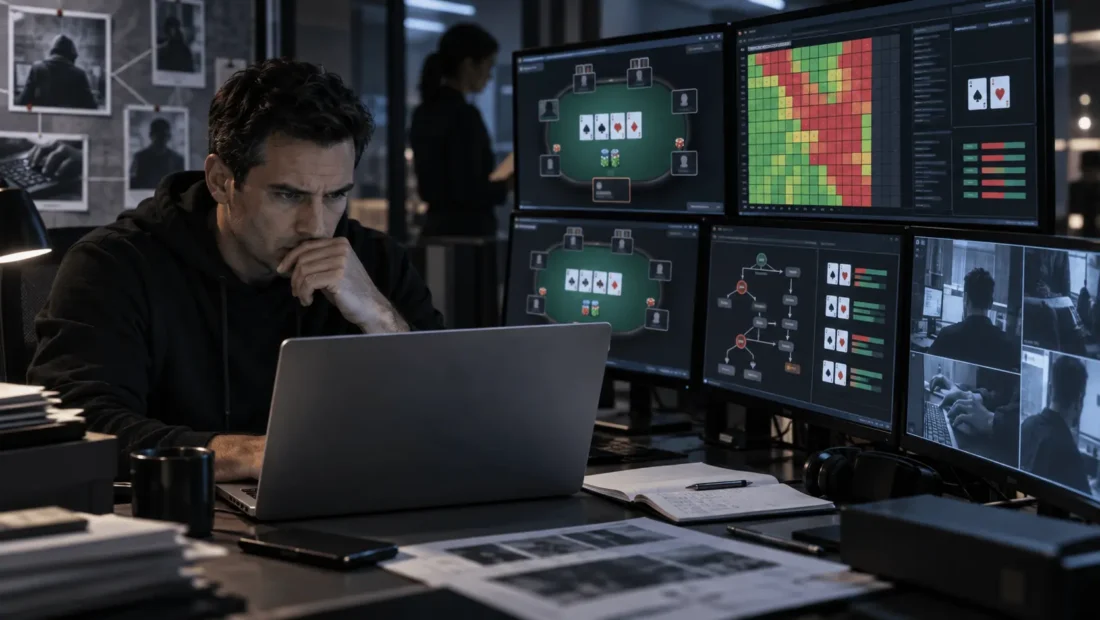
ACR Poker has opened an investigation after a viral video appeared to show a player using a real-time assistance overlay while playing on the site. The footage, posted on X and viewed more than 110,000 times, triggered a fresh debate about the use of solver-based tools during live online poker hands and the ability of operators to detect them.
The player’s identity was redacted in the circulating video. What made the case especially unusual was that the original clip was posted by TrenirusGTO itself to promote its software, before being amplified by poker players who argued that the demonstration showed prohibited real-time assistance in action.
Why the video caused such a strong reaction
The concern is not simply that a player was studying poker strategy while logged into a site. Real-time assistance, commonly shortened to RTA, refers to tools that provide strategic guidance while a hand is actually being played. That timing is the central issue because the software can influence decisions against real opponents rather than helping a player review situations later.
A player using the handle ‘firenkes’ highlighted the video and described it as a solver being used during a live hand. The post argued that if poker sites do not track and block that behaviour, the result is effectively legalized cheating, with recreational players placed at a disadvantage against whoever has the overlay running.
That framing quickly pushed the clip beyond a normal software demonstration. The debate became about game integrity, not training technology. Solvers and analytical tools are widely used away from the table, but operators draw a line when similar assistance is available in real time during active play.
ACR confirms an investigation is underway
ACR Poker responded with a detailed statement confirming that it was investigating the video. The site said it was working to identify the player and account involved and to determine whether other accounts or players may also be connected.
The operator’s statement was explicit that RTA is prohibited. ACR said using a tool to provide GTO-based or other strategic assistance during a live hand violates its Security and Game Integrity rules. It also said the platform would continue taking decisive action against prohibited tools.
The investigation therefore has at least two layers. The first is establishing which account appears in the video and whether the footage reflects genuine play on ACR. The second is determining whether the behaviour is isolated or part of a wider pattern involving additional users.
Phil Nagy says users caught with RTA face permanent bans
ACR Poker CEO Phil Nagy also responded publicly. He described ACR as the last place a player would want to use RTA and said users caught doing so would be banned for life.
That is a strong enforcement message, but the viral reaction shows why detection matters as much as policy language. A rule against RTA is only effective if an operator can identify prohibited use with enough confidence to act on it. The sophistication of newer tools is what has made this issue increasingly prominent among high-volume online players.
The video gives the discussion something concrete to focus on. Instead of players speaking abstractly about what may be possible, the clip appears to show an overlay being used next to a live poker client. That visibility is one reason the response spread so quickly.
Chris Moneymaker calls the behaviour blatant cheating
ACR ambassador Chris Moneymaker reacted directly to TrenirusGTO. He rejected the idea that this type of software should be viewed as a way to improve while playing and called the conduct shown in the video “blatant cheating.” He also warned that anyone caught using it would have funds confiscated.
Moneymaker’s position is important because he represents the same site now investigating the incident. His comments align with ACR’s official statement: the issue is not the existence of strategy software itself, but its use to provide decisions during live hands.
That distinction is likely to remain central to the conversation. Poker players routinely study hand histories, watch training content and use analytical software away from active tables. The integrity concern begins when those tools are converted into a live decision engine operating against opponents who assume they are playing another person without prohibited assistance.
Patrick Leonard says the visible example may be only a small part of the problem
UK professional Patrick ‘Pads’ Leonard called the video “very scary.” He went further by suggesting that the clip represented less than one percent of the more serious RTA concerns regular players had been discussing during the previous week.
His reaction shifts the focus from one visible account to the possibility of a broader technological problem. A promotional video is easy to notice because it is public. Tools being used privately by players who have no reason to advertise them are much harder for the community to see.
That does not prove how widespread RTA is on any particular platform. The source does not provide evidence that the practice is common across ACR or online poker as a whole. It does, however, show that respected professionals are concerned the visible case may not be the most sophisticated version of the technology.
Matt Berkey points to AI lowering the barrier to building tools
Matt Berkey connected the issue to the rapid development of artificial intelligence. His argument was that it is becoming easier to build tools capable of delivering useful information quickly, so the question is increasingly about the quality of the assistance rather than whether some form of real-time help exists.
That concern goes beyond traditional solver software. Modern AI systems can make interfaces easier to build, connect and customise. A tool does not need to look like a classic poker solver if it can still process a game state and return strategically useful information fast enough to influence a decision.
Berkey’s comments are an opinion about the direction of the technology, not evidence about the specific account in the viral video. Still, they explain why the clip has attracted attention beyond one platform. The underlying fear is that the cost and technical difficulty of creating sophisticated assistance may continue to fall.
Why RTA is especially damaging to online poker
Poker depends on players believing that the decisions at the table are being made by the people occupying the seats. Participants can have different levels of skill, preparation and theoretical knowledge, but the competitive premise is that each player is choosing actions in real time without an external engine supplying optimal answers.
RTA challenges that premise directly. A player receiving solver-informed recommendations during a hand gains a form of assistance that opponents cannot account for through ordinary reads or strategic adjustment. The problem is not simply that the user may play better. It is that the source of those decisions has changed.
This is why the reaction from professionals has focused so heavily on recreational players. If casual users believe they are regularly facing hidden software assistance, confidence in the games can deteriorate. Even the suspicion of widespread RTA can be damaging if operators cannot demonstrate credible detection and enforcement.
The software provider’s own promotion makes this case unusual
The final lines of the source describe the incident as another stage in the technological contest between poker sites and cheaters. What makes this episode different is that the software provider itself appears to have promoted the use case publicly.
That creates a striking contrast. Operators usually discover prohibited software through detection systems, reports or account reviews. Here, the promotional material itself appears to have shown the behaviour that players and ACR identify as against the rules.
The public nature of the clip may make this individual case easier to investigate, but it also raises the larger question highlighted by Leonard and Berkey: what happens when similar tools are used privately and designed specifically to avoid attention?
What ACR now needs to establish
The operator has already said it is trying to identify the player and account shown in the footage. It also wants to determine whether any additional accounts or users were involved. Those are factual questions that can potentially be resolved through account records, security analysis and whatever information ACR can obtain from the video.
The public statements do not yet provide the outcome of that investigation. There is no confirmed identity in the source and no announced sanction tied to this specific clip. For now, the strongest verified point is that ACR regards the conduct shown as prohibited and says it is actively investigating.
That distinction matters because a viral video can encourage speculation to move faster than the evidence. The operator’s eventual findings will determine whether the footage leads to a specific account action and whether the investigation expands beyond a single player.
The wider technology race is likely to continue
The source closes on a broader concern shared by several commentators: AI is making sophisticated tools easier to create, while poker operators are under pressure to improve detection at the same time. That produces a continuing cycle in which assistance software becomes more capable and security teams have to adapt.
There is no simple endpoint described here. ACR can ban RTA, investigate visible cases and sanction users it catches, but the technology itself continues to develop. Players, meanwhile, want evidence that sites can enforce the rules strongly enough to protect the games.
The viral TrenirusGTO video has become a useful flashpoint because it makes an abstract fear visible. ACR has responded by opening an investigation and reaffirming that live strategic assistance is prohibited. Moneymaker has called the conduct cheating, Leonard has warned about a potentially wider problem, and Berkey has pointed to AI as a force making these tools easier to build.
For online poker, the next important development is not another social-media reaction but the result of the investigation and the security response that follows. The central issue is trust. If players are expected to compete against people making their own decisions, operators have to show that software making those decisions in real time is not allowed to become part of the game.