
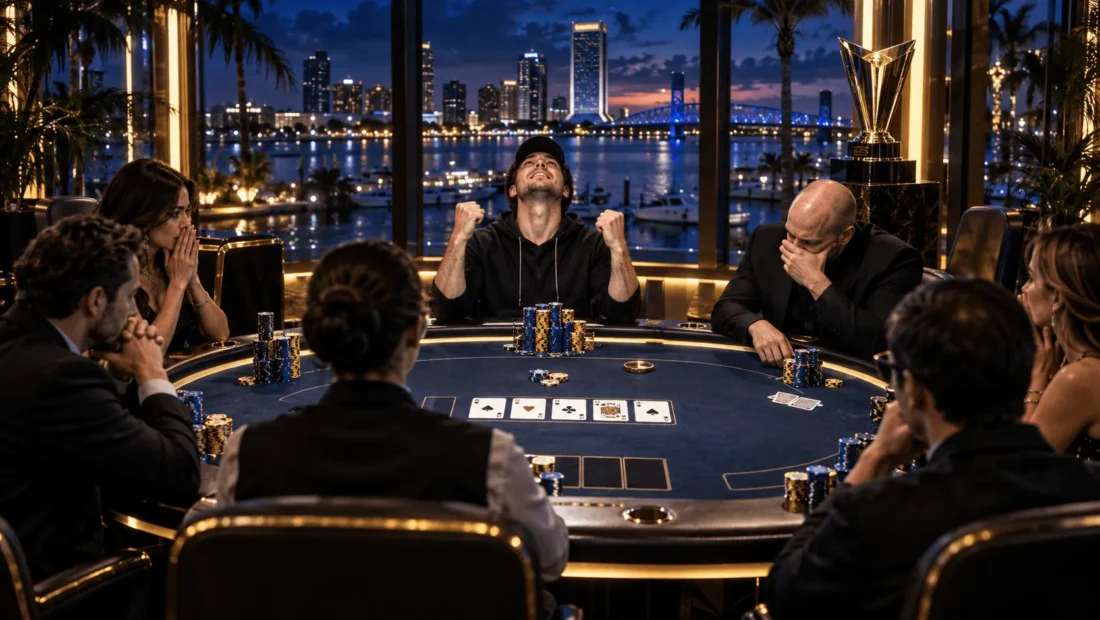
Blake Ellinghaus has joined the WPT Champions Club after winning the $5,000 WPT bestbet Scramble Championship at bestbet Jacksonville. The Illinois player defeated Jared Reinstein heads-up, rivered the straight that decided the final hand and collected $294,900 for the biggest tournament cash of his career.
The result was a dramatic jump from Ellinghaus’ previous live record. He entered the tournament with roughly $140,000 in recorded live cashes and qualified through a $580 satellite rather than buying directly into the $5,000 event. A few days later, he was holding a World Poker Tour title and a payout worth more than twice his prior career total.
The event attracted 294 entries and played for a $1 million guaranteed prize pool at bestbet Jacksonville in northern Florida. Ellinghaus was near the top of the leaderboard almost from the start. He ended Day 1a second in chips, finished Day 2 in the same position and then moved into the outright lead on Day 3 before the televised final table.
That consistency did not make the last stage easy. Bryan Paris took over the lead early, Reinstein won a major pot against Ellinghaus and Hugh Membrino doubled through the eventual champion. Ellinghaus had to absorb each setback, rebuild and then eliminate several of the players who had taken chips from him.
A Long Run Near the Top of the Counts
Ellinghaus’ path to the title was unusual because his stack never really disappeared from the top end of the leaderboard. Finishing second in chips on consecutive days gave him room to survive the natural swings of a deep tournament, and taking the lead before the final table meant he arrived with both chips and momentum.
Still, a final-table lead is only temporary capital. Paris, one of the most accomplished online players in the field, went on an early surge and briefly controlled the action. Reinstein then took a significant pot from Ellinghaus, while Membrino won a roughly 60/40 confrontation to double his stack. For a player who had led entering the day, the pressure shifted quickly.
The important part of Ellinghaus’ performance was that he did not react by forcing the issue. He stayed close enough to the leaders to keep playing meaningful pots and waited for spots where the cards and stack sizes allowed him to fight back. The first major reversal came against Membrino.
| Place | Player | Prize |
| 1 | Blake Ellinghaus | $294,900 |
| 2 | Jared Reinstein | $184,000 |
| 3 | Bryan Paris | $135,000 |
| 4 | Skyler Dennis | $100,000 |
| 5 | Michael Macchia | $75,000 |
| 6 | Hugh Membrino | $57,000 |
Membrino Exit Restores Ellinghaus
Ellinghaus recovered the chips he had lost to Membrino when the two collided again. Ellinghaus flopped top pair with top kicker, while Membrino held top pair with a weaker kicker. The stronger hand held, sending Membrino out in sixth place for $57,000.
That elimination mattered for more than the payout ladder. It returned a large amount of ammunition to Ellinghaus at a point when Paris and Reinstein had been applying pressure. The final table was still balanced enough for another swing, but Ellinghaus was back in a position to dictate more hands instead of simply defending his stack.
Reinstein then eliminated Michael Macchia in fifth place. Pocket aces held for Reinstein, and Macchia collected $75,000. With five reduced to four, every remaining player was guaranteed at least $100,000, raising both the financial stakes and the value of each decision.
Dennis and Paris Fall as the Lead Becomes Permanent
Skyler Dennis was the next player to double through Ellinghaus, another reminder that the eventual champion’s run was not a smooth march. Yet the pattern repeated: Ellinghaus lost chips, stayed composed and later got them back. Dennis eventually exited in fourth place for exactly $100,000.
This time the recovery did more than stabilize Ellinghaus. After Dennis was eliminated, Ellinghaus pushed into a chip lead that he would never surrender again. The three-handed phase featured Ellinghaus, Paris and Reinstein, with a substantial difference between third-place money and the top two prizes.
Paris’ run ended when his pocket nines ran into Ellinghaus’ pocket jacks. The larger pair held, eliminating Paris in third for $135,000 and giving Ellinghaus the chance to begin heads-up play with a commanding advantage.
A 6-to-1 Heads-Up Lead
When heads-up play started, Ellinghaus held roughly six times as many chips as Reinstein. That kind of lead does not guarantee a title, particularly in no-limit hold’em, and Reinstein did manage to double once to make the contest more competitive. But he never completed the full comeback.
The final hand produced the kind of river that tends to define a championship recap. Reinstein had flopped a straight draw. Ellinghaus eventually improved to a straight on the river, moved all-in and received a call. Reinstein had paired the river rather than completing the draw, and the call ended the tournament.
Reinstein earned $184,000 for second place, while Ellinghaus took the $294,900 first prize. The difference between the two payouts was substantial, but for Ellinghaus the title itself may carry the longer legacy because it places his name on the WPT Champions Club list.
From $580 Satellite to WPT Champion
The qualification route makes the win even more striking. Ellinghaus entered via a $580 satellite, meaning the tournament cost only a fraction of the direct $5,000 buy-in. Satellite success alone does not change the difficulty of the main event, of course. Once seated, he still had to outlast 293 other entries and survive a final table filled with experienced opponents.
Before this week, Ellinghaus had approximately $140,000 in live cashes. The $294,900 prize therefore represents a major career inflection point. One event more than tripled the scale of his recorded results and transformed him from a player with modest live totals into a World Poker Tour champion.
His route through the final table also gives the result a little more substance than a story built around one lucky river. Ellinghaus had been a big stack for days, handled multiple setbacks, eliminated Membrino, Dennis and Paris, and entered heads-up with a huge lead. The rivered straight decided the last hand, but the position to benefit from it had been built over the entire tournament.
For bestbet Jacksonville, the 294-entry field delivered a strong finish to a $1 million guaranteed event. For Ellinghaus, it produced the biggest payday of his career, his first WPT title and a result that will now define his live résumé.
Further Context
The final-table sequence is a useful reminder that a chip lead is a resource rather than a guarantee. Ellinghaus repeatedly watched opponents take chips from him, but because he had built such a strong position over the previous days, he could survive those reversals and keep looking for better spots.
His satellite route also adds a second layer to the result. Turning $580 into a seat is one achievement; converting that seat into a title against a 294-entry field is another entirely. The main-event performance still had to stand on its own once the satellite ticket had done its job.
By the time heads-up started, Ellinghaus had created enough separation to absorb Reinstein’s double-up without losing control of the match. That cushion mattered on the final hand, because it allowed him to apply maximum pressure when the river completed his straight.
The payout ladder also shaped the final four. Dennis secured $100,000, Paris moved to $135,000, Reinstein earned $184,000 and Ellinghaus claimed $294,900. Those jumps meant that the pressure was not limited to the trophy; every elimination materially changed the value of the result.
Paris’ presence was especially relevant because his online résumé made him one of the most experienced players left. Ellinghaus eliminating him with jacks over nines removed a dangerous opponent and created the heads-up chip advantage that ultimately proved decisive.
Reinstein deserves credit for extending the match despite starting heads-up at roughly a six-to-one disadvantage. His double-up showed that the contest was not finished, but Ellinghaus had enough depth to keep applying pressure without becoming vulnerable to one lost pot.
The win therefore combines several different tournament narratives: a satellite qualifier, a long-running chip leader, multiple final-table setbacks and a dramatic river on the final hand. Any one of those details could define a smaller result; together they explain why this became the clear landmark of Ellinghaus’ live career.
There is also a useful distinction between winning chips and keeping them. Paris and Reinstein both showed they could take control of individual stretches, but Ellinghaus repeatedly rebuilt after losing momentum. Tournament leaders often fail because one setback becomes two or three; his strongest trait at this final table was preventing temporary losses from turning into a complete collapse.
By the final three, the story had come full circle. Ellinghaus entered the final table in front, briefly lost that status, then eliminated Paris to restore a dominant position. The eventual heads-up advantage was therefore not inherited from the start of the day; it had to be rebuilt through the most competitive stage of the tournament.
That progression makes the $294,900 first prize feel less like a single-hand story and more like the result of sustained control. The rivered straight is the memorable finish, but the title was built through four days of chip accumulation, recovery after setbacks and timely eliminations. For a player entering with about $140,000 in previous live cashes, the scale of the breakthrough is difficult to overstate.