
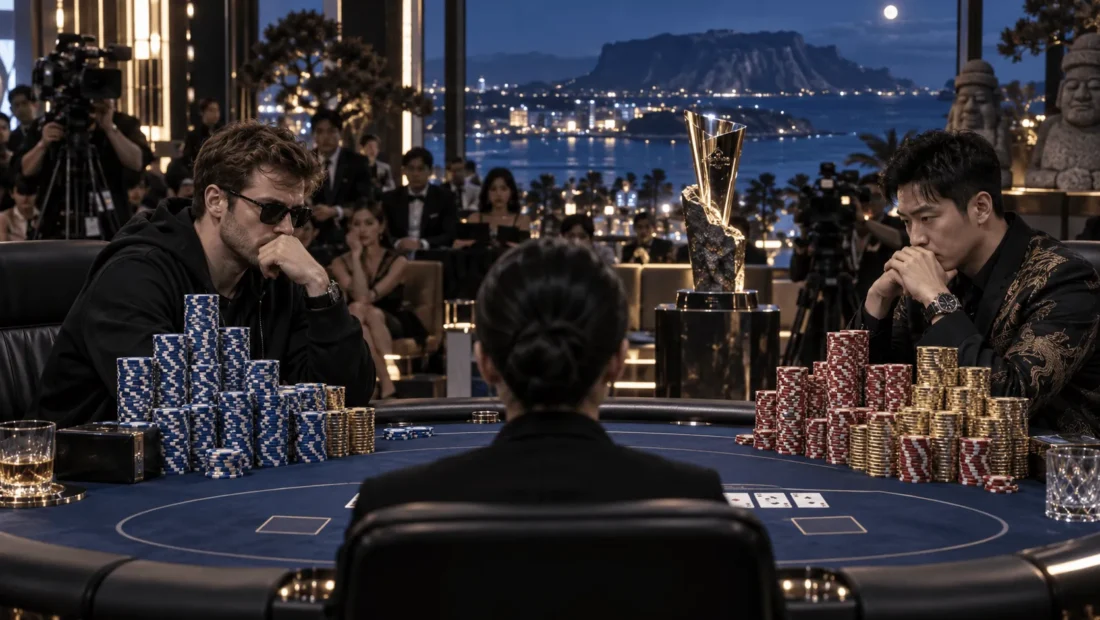
Triton Poker has announced a heads-up match large enough to stand apart even in the super-high-roller world. Poker Hall of Famer Patrik Antonius is set to face businessman and cash-game player Ossi “Monarch” Ketola for $20 million on Friday evening at the Triton Super High Roller Series Jeju II stop in South Korea.
Triton is billing the contest as the biggest televised heads-up match in poker history. The action will be livestreamed through Triton Poker’s own streaming channels, including YouTube and the Triton Poker Plus app, turning what would normally be a private nosebleed cash confrontation into a global broadcast event.
A $20 Million Match Built for the Spotlight
The headline number immediately changes the scale of the contest. High-stakes heads-up poker has always produced large swings, but a match explicitly framed around $20 million places every major pot under extraordinary pressure. The two players will not only be competing against each other; they will be doing it in front of a live audience that can follow every visible decision, timing choice and momentum shift.
Triton has increasingly turned elite cash-game action into part of its public identity. Tournament trophies remain central to the series, but streamed private-game style sessions and heads-up challenges offer a different kind of drama. There is no field to survive and no payout ladder. The story is reduced to two players, two stacks and a direct contest in which the financial swings can become enormous very quickly.
That format suits both participants for different reasons. Antonius brings one of the most recognizable reputations in modern high-stakes poker. Ketola brings recent experience in exactly the type of huge, confrontational cash games that have generated headlines around Triton over the last two years.
Antonius Brings Hall of Fame Experience
Patrik Antonius enters the match with the status of a Poker Hall of Famer and decades of experience at the highest levels of cash poker. That background matters in a heads-up setting because the format strips away many of the dynamics found in a full-ring game. There is no opportunity to wait for other players to collide. Both participants are involved in every hand, and small strategic adjustments can be repeated against the same opponent again and again.
The announcement does not need to rely on a long list of recent Antonius results to create intrigue. His reputation is already the point. He represents the established elite of high-stakes poker, a player associated with technically demanding cash games long before streamed million-dollar pots became regular social-media clips.
That makes the matchup easy to understand even for viewers who have not followed every Triton session. On one side is an experienced Hall of Fame professional. On the other is a businessman and cash-game specialist whose recent willingness to play enormous pots has made him one of the most discussed figures in the high-stakes scene.
Ketola Has Already Produced Record-Breaking Pots
Ossi Ketola’s rise as a public high-stakes personality has been fast. At the same festival last year, the Finnish player won a $10.99 million pot against Alex Foxen, a result that immediately became one of the largest and most widely discussed pots ever shown from a poker broadcast.
His 2025 heads-up matches then became a recurring story. Ketola played Kayhan Mokri and Dan “Jungleman” Cates, among others, while continuing to appear in Triton’s biggest cash settings. Those sessions established a clear pattern: Ketola is prepared to play opponents with elite professional credentials while accepting swings that would be unthinkable in ordinary cash games.
He reinforced that image only days before the Antonius announcement. Ketola faced Wiktor “Limitless” Malinowski in a series of games featuring multiple pots worth more than $1 million. By the end of the confrontation, Ketola had emerged approximately $6 million ahead.
Why the Match Is Different From a Tournament Final
A $20 million heads-up cash match creates a very different decision environment from a tournament. Tournament players constantly account for blind increases, payout jumps and the possibility of elimination. In a cash-style confrontation, chip value is more direct. The central questions become stack depth, hand selection, bet sizing, opponent tendencies and the willingness to keep taking high-variance lines when the amounts involved are enormous.
The psychological pressure can also be more concentrated. In a tournament, a difficult hand may be followed by a table change or a long period in which other players occupy the spotlight. Heads-up poker offers no such escape. The same opponent is there on the next hand, and the next, with every previous pot feeding into the evolving dynamic.
For viewers, that repetition can make the match easier to follow strategically. Patterns become visible. One player may begin calling wider, raising more frequently or changing bet sizes in response to what happened earlier. Because there are only two participants, the audience can connect those adjustments directly to the history that develops over the session.
Triton Turns Nosebleed Poker Into a Broadcast Event
The decision to livestream the match is almost as important as the stake itself. Private high-stakes poker has always produced stories about spectacular wins and losses, but those stories often reached the public only after the fact. Triton’s streaming model allows fans to watch the tension unfold in real time rather than reading a result later.
That changes the value of the match for everyone involved. For Triton, it creates a marquee broadcast around two recognizable players and a record headline figure. For the players, it places their decisions under far more scrutiny than they would face in a private room. For the audience, it turns abstract numbers into visible moments: an all-in bet, a long tank, a river card and the physical reaction to a pot worth millions.
Jeju is also a fitting setting because Ketola already has history there. His record $10.99 million pot against Foxen was won at the festival, and his recent return to the same environment has again produced enormous swings. The Friday match therefore feels less like an isolated exhibition and more like the next chapter in a run of public nosebleed games.
A Contrast in High-Stakes Identities
The matchup works because Antonius and Ketola arrive with different poker identities. Antonius is the established professional, known for a career built across elite cash games and major tournament environments. Ketola has become the disruptive modern figure, a businessman willing to sit with the strongest specialists and play for sums large enough to dominate poker discussion.
That contrast does not determine the result. Heads-up matches can turn on strategy, execution and short-term variance, and the source announcement does not specify every structural detail of the game. What it does establish is the scale: $20 million, a Friday-night Jeju setting and a full livestream.
The recent Malinowski result will inevitably shape expectations around Ketola because he enters the match after a roughly $6 million win. Antonius, meanwhile, brings a reputation that makes him a very different kind of opponent from a celebrity exhibition player. Triton has paired a recent headline-maker with one of high-stakes poker’s most established names.
What to Watch on Friday
The obvious attraction is the money, but the most interesting part may be how quickly the strategic tone becomes clear. Heads-up games often develop an internal rhythm within the first few orbits. Frequencies change, bet sizes expand or contract, and players begin testing which lines the opponent is willing to defend.
With $20 million attached to the contest, even relatively routine pots can become important because they shape stack distribution and confidence. A single huge confrontation may define the broadcast, as Ketola’s previous record pot did, but the match can just as easily be decided by a long sequence of smaller edges.
Triton has created the conditions for a rare kind of poker spectacle: a record-scale heads-up match involving two players who do not need an artificial storyline. Antonius brings Hall of Fame credibility, Ketola brings recent multimillion-dollar momentum, and Jeju brings the stage on which some of the largest public cash-game pots have already been played.
The match is scheduled for Friday evening local time in South Korea and will be available through Triton’s streaming platforms. However the chips move, a $20 million Antonius-Ketola showdown is positioned to become one of the defining high-stakes broadcasts of the year.
Recent Momentum Makes Ketola a Particularly Timely Opponent
Ketola’s recent $6 million win over Malinowski gives the announcement additional immediacy. It means the $20 million match is not being promoted on reputation alone; one participant is coming directly from another series of enormous heads-up pots. That recent result will not determine what happens against Antonius, but it ensures viewers have a clear reference point for Ketola’s current willingness to play aggressively at extraordinary stakes.
Antonius presents a different challenge because his career has been built around adapting to elite opposition over a very long period. The contrast between current momentum and deep experience is part of what makes the pairing more compelling than a simple exhibition. Both players arrive with reasons to believe they are comfortable in the environment, which leaves the table rather than the marketing to settle the argument.