
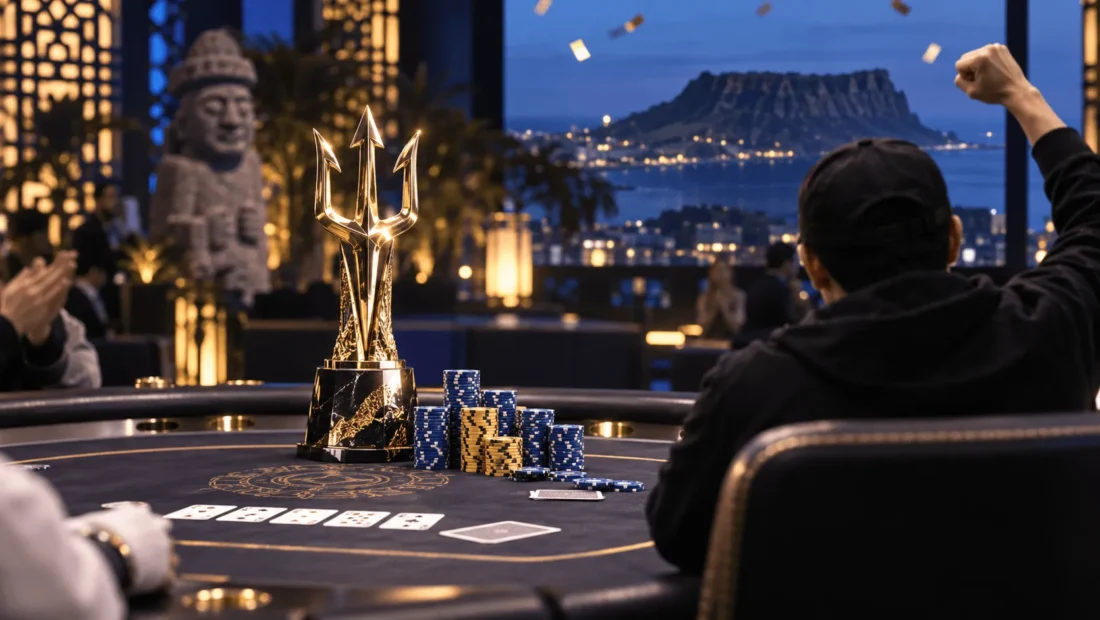
Klemens Roiter had already built the kind of tournament record most poker professionals would happily take. Over the last two seasons, the Austrian had collected major scores, made repeated deep runs in elite fields and shown that he could compete comfortably against the biggest names on the high-roller circuit. One thing, however, had continued to stay just out of reach: a Triton trophy.
That changed in Jeju. Roiter came through a 174-entry field in the $20,000 no-limit hold’em event, completed a major heads-up comeback against Alejandro Lococo and collected $771,000 for first place. More importantly for him, the victory finally delivered the Triton title that had been missing from his resume.
The breakthrough came at Roiter’s 13th career Triton final table. The number says a lot about how close he had been before this event. He was not arriving in Jeju as a player looking for his first meaningful result on the tour. He had already spent years putting himself in position to win. In May, he had come especially close when he finished runner-up in the $100,000 no-limit hold’em main event in Montenegro.
Roiter’s reaction after the final hand made clear that the trophy carried more emotional weight than an ordinary high-stakes payday. Speaking with Triton’s Stanley Ma shortly after the win, he said he was still shaking and described himself as extremely happy and proud. For a player who had accumulated almost everything except a Triton title, the result felt like the closing of a very specific gap.
A Breakthrough After a Huge Two-Year Run
Roiter’s first Triton victory did not arrive in isolation. Since the beginning of 2025, his tournament results have accelerated sharply. He won the $1,500 World Series of Poker Monster Stack for more than $1.2 million and repeatedly reached Triton Super High Roller final tables. By the time he sat down in Jeju, his career tournament earnings were already approaching $15 million.
That background made the absence of a Triton trophy increasingly noticeable. Reaching final tables in these fields is difficult enough, and doing it over and over again usually points to more than a short hot streak. Yet tournament poker can still withhold the final step. A player can navigate hundreds of decisions correctly and then lose one decisive all-in, run into a stronger hand, or simply enter heads-up play with too large a chip deficit.
Jeju looked capable of becoming another near miss. Roiter did not dominate the final table from start to finish, and when the tournament was reduced to two players, Lococo held the advantage. The Austrian instead had to survive the middle stages, wait for the right opportunities and then reverse the direction of the match when it mattered most.
The win also added another result to Roiter’s strong 2026 campaign. He earned 936 Card Player Player of the Year points and moved into eighth place in the yearlong race presented by CoinPoker. It was his second title and 12th final-table finish of the year, following a victory in a €10,200 six-max event at the European Poker Tour Barcelona stop only a week earlier.
Early Triton Action in Jeju
The $20,000 event was the second tournament on the Jeju schedule. Alexandros Theologis had already opened the festival by winning the first event, which attracted more than 200 entries. The next tournament kept the momentum going, with 174 entries generating a $3,480,000 prize pool.
The top 27 finishers were paid. The money bubble burst late on day 1, leaving 25 players to return for the second day. From that point, the tournament became a short, high-pressure sprint toward the final table. Every elimination increased the value of the remaining seats, but the players still had to balance payout pressure against the need to accumulate enough chips to challenge for the title.
When the field combined to an unofficial final table of nine, Roiter was not the clear leader. He sat closer to the middle of the pack while Yu Zhang and three-time Triton winner Webster Lim controlled the largest stacks. Jesse Lonis, the defending Card Player Player of the Year and a four-time Triton champion, was also still involved.
That lineup gave the closing stages plenty of established high-roller experience. Roiter’s path to the trophy therefore required more than simply waiting for short stacks to disappear. He needed to preserve his own stack while several accomplished opponents were still capable of taking control with one double-up or one large pot.
Lonis, Zhang and Lim Exit as the Final Table Tightens
Lonis was the first of the major contenders to suffer a painful exit. He held pocket jacks against Lococo’s J♦7♠, but the board quickly moved against him. A seven on the flop was followed by another seven on the turn, giving Lococo trips. The chips went in after the turn, and Lonis was unable to find the single remaining jack that would have restored his lead.
The elimination sent Lonis out in eighth place for $94,000. He also received 156 POY points, enough to move him into fourth place overall in his attempt to win consecutive Player of the Year titles. It was not the finish he wanted in Jeju, although the result still added to another highly productive season.
Justin Saliba then took care of Yu Zhang. Saliba’s pocket aces held against Zhang’s K♥8♠, ending Zhang’s tournament in seventh place for $130,000. Webster Lim followed in sixth. The three-time Triton champion got his chips in with A♠K♥ but failed to improve against fellow Triton winner Mehdi Chaoui, collecting $179,000 for his run.
Those eliminations gradually changed the shape of the table. The early chip leaders were disappearing, while Lococo was becoming increasingly difficult to contain. Roiter remained alive, but at this stage the event looked more and more like Lococo’s tournament to lose.
Lococo Builds a Runaway Lead
Lococo eliminated Justin Chu in fifth place, worth $233,000, and then found the hand that gave him a commanding advantage. He held A♣10♠ in a three-way all-in against Chaoui’s pocket nines and Saliba’s Q♠J♦. The pot offered the possibility of a double knockout and a huge swing in the final-table balance.
Initially, the board favored Saliba. The J♣8♣7♥ flop gave him top pair, and the Q♣ turn improved him to two pair. Lococo, however, still had live possibilities. The 9♣ on the river completed a club flush for him, allowing him to win the enormous pot and eliminate both opponents at once.
Because Chaoui had the shorter stack, he finished fourth for $292,000. Saliba moved one place higher and earned $358,000 for third. The double elimination immediately set the heads-up match and left Lococo with roughly a 2.5-to-1 chip lead over Roiter.
On paper, that was the moment at which Roiter’s long wait for a Triton title could easily have continued. Lococo had momentum, the larger stack and the ability to apply pressure without risking his entire tournament in every pot. Roiter needed to change the dynamic quickly enough that the match did not simply drift away from him.
Roiter Flips the Heads-Up Match
Roiter found an early double-up and brought the stacks much closer. That recovery created the conditions for the hand that effectively decided the tournament. From the big blind, Roiter checked with 7♦2♣ and saw a board run out 10♣7♥5♦7♠5♥.
By the river, his unremarkable starting hand had become a full house. Roiter moved all-in, putting Lococo in an uncomfortable position. The board itself showed two pair, and Lococo held a queen-high kicker to those paired cards. After working through the decision, he made the call.
The call was disastrous for Lococo’s stack. Roiter’s full house was comfortably ahead, and the pot left his opponent with only a small number of chips. Lococo managed one double-up afterward, but the comeback never fully started. On the final hand, Lococo’s A♠9♦ went up against Roiter’s 10♥8♥. Roiter paired his eight and finally closed out the event.
What made the heads-up sequence memorable was not only the 7-2 hand itself. It was the speed with which the entire contest changed. Lococo had entered heads-up with a substantial advantage and had just eliminated two players in one hand. Roiter first neutralized that lead and then found a spot where a disguised full house produced maximum value.
That kind of reversal is part of why a first major title can take so long even for a player with consistent results. Final tables are not won by career earnings or previous placements. The last few opponents still have to be beaten in the exact tournament being played, and in Jeju Roiter finally converted his opportunity.
What the Win Means for Roiter
The $771,000 first prize pushed Roiter’s career tournament earnings beyond $15.7 million. More than $9.1 million of that total has now come in Triton events, an unusually large share that reflects how frequently he has reached the late stages of the tour’s high-stakes tournaments.
There was also a sense of relief in his comments after the victory. Roiter joked that he could potentially retire now that the missing trophy had finally arrived, before quickly adding that he did not think he was finished yet. Given the form he has shown across 2025 and 2026, the second part of that comment may be the more relevant one.
A first title can alter the way a string of previous close finishes is remembered. Before Jeju, Roiter’s Triton record could be described as impressive but incomplete. After Jeju, those earlier final tables look more like evidence of a player repeatedly putting himself in a position where a win was eventually likely to come.
The result also keeps him firmly involved in the 2026 Player of the Year conversation. Eighth place is not the same as leading the race, but two titles and 12 final tables create a substantial base. With major events still offering large point totals, another deep run could quickly change his position.
Final Table Results
The final eight players shared more than $2.5 million in payouts, with Roiter and Lococo taking the two largest prizes. The official results were:
| Place | Player | Payout | POY Points |
| 1 | Klemens Roiter | $771,000 | 936 |
| 2 | Alejandro Lococo | $520,000 | 780 |
| 3 | Justin Saliba | $358,000 | 624 |
| 4 | Mehdi Chaoui | $292,000 | 468 |
| 5 | Justin Chu | $233,000 | 390 |
| 6 | Webster Lim | $179,000 | 312 |
| 7 | Yu Zhang | $130,000 | 234 |
| 8 | Jesse Lonis | $94,000 | 156 |
For Roiter, the numbers tell only part of the story. The prize money and POY points add to an already excellent season, but the trident itself was the achievement he had been chasing. After 12 previous Triton final tables without a win, the 13th finally ended differently.