
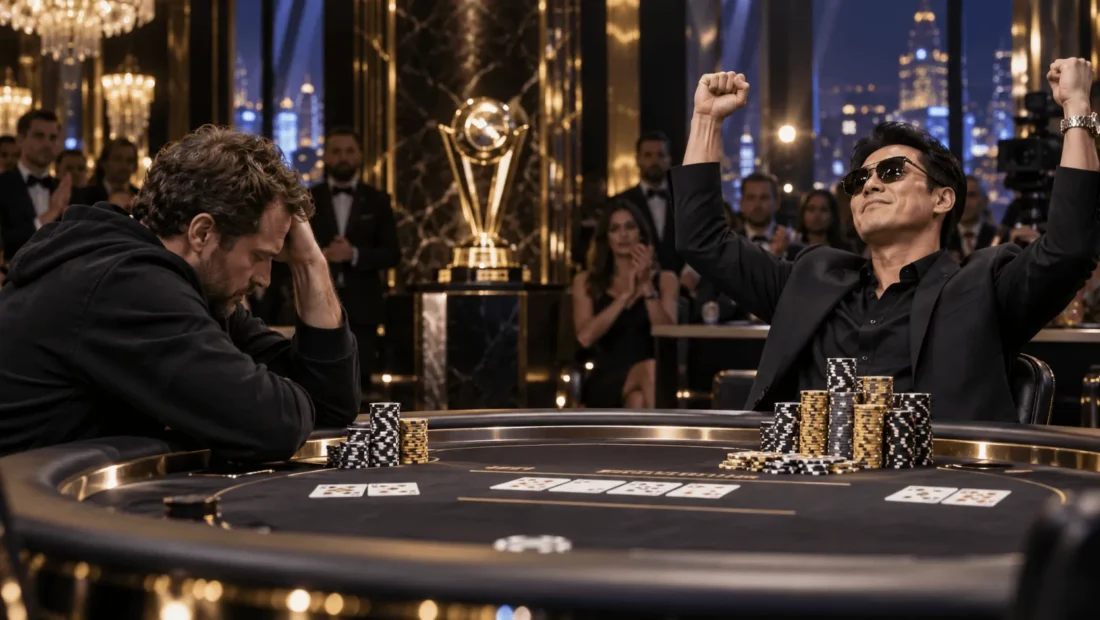
Nick Petrangelo closed a strong Triton Poker Series Jeju II with victory in the $150,000 10th Anniversary Special, officially taking first place after a heads-up deal with Joao Simao. Petrangelo received $2,212,910 for the win, while Simao secured the larger $2,517,090 payout under the deal.
The unusual finish came after the two long-time friends reached heads-up and agreed to divide the remaining prize money. Rather than play an extended final battle for the trophy, they chose to settle the title with blind all-ins. It took only three hands for Petrangelo to win the remaining chips and become the official champion.
Petrangelo finally converts a deep run into a title
The victory was especially meaningful because Petrangelo had already made several deep runs during the festival. He recorded five cashes and had repeatedly come close to a major result before finally breaking through in one of the series’ most expensive events.
For Simao, second place still added another enormous score to an exceptional Jeju series. He had already won the $200,000 Invitational for $7.25 million, the largest payday of his career, before reaching another heads-up contest in the Anniversary Special.
A final table packed with established high rollers
The final table included many of the most familiar names in high-stakes tournament poker. Adrian Mateos finished third for $1,286,000, followed by Miroslav Atanasov in fourth for $990,000 and Thomas Boivin in fifth for $783,000.
Murly Manokharan took sixth for $613,000, Danny Tang finished seventh for $483,000, Seth Davies collected $377,000 in eighth and Dan Dvoress earned $286,000 for ninth.
The payouts show the scale of the event. Even ninth place was worth more than a quarter of a million dollars, while the top four all approached or exceeded seven figures. The field itself reached 67 entries after nine additional players joined the 26 returning from Day 1.
The presence of Petrangelo, Simao, Mateos, Boivin, Tang, Dvoress and Davies at the same final table also explains Petrangelo’s comments about the narrow edges in modern high-roller poker. At this level, a player can perform well across multiple events and still repeatedly finish outside the top few positions.
Triton $150K Anniversary Special Final Table Results
| Place | Player | Country | Prize |
| 1 | Nick Petrangelo | United States | $2,212,910* |
| 2 | Joao Simao | Brazil | $2,517,090* |
| 3 | Adrian Mateos | Spain | $1,286,000 |
| 4 | Miroslav Atanasov | Bulgaria | $990,000 |
| 5 | Thomas Boivin | Belgium | $783,000 |
| 6 | Murly Manokharan | Malaysia | $613,000 |
| 7 | Danny Tang | Hong Kong | $483,000 |
| 8 | Seth Davies | United States | $377,000 |
| 9 | Dan Dvoress | Canada | $286,000 |
Day 2 quickly reduced the late-entry field
Day 2 began with 26 returning players and nine late entrants. Many of the newcomers had only around 20 big blinds, which left little room for error. Several prominent players were eliminated before the first break, including Punnat Punsri, Jesse Lonis, Jamil Wakil, Ding Biao, Samuel Mullur, Michael Watson and Phil Ivey.
Isaac Haxton briefly created one of the day’s biggest early moments by making a flush and eliminating Stephen Chidwick and Brandon Wilson in the same hand. Daniel Dvoress then produced an even rarer triple knockout against Sam Greenwood, Matthias Eibinger and Patrik Antonius, moving sharply up the leaderboard.
The money bubble did not last long. Wai Kiat Lee ran ace-queen into Danny Tang’s ace-king and missed the opportunity to improve, finishing one place short of the payouts. Even so, Lee had already enjoyed a successful festival that included victory in the $40,000 Mystery Bounty and three additional cashes.
Alex Foxen became the first player eliminated after the bubble. He found a double-up immediately after the money was reached, but later lost when Seth Davies outflopped him.
Boivin surges, then Atanasov takes control
Thomas Boivin became one of the central figures before the final table. He doubled through Ben Tollerene and later made a straight that was paid off, moving into the chip lead. Tollerene then lost more chips to Murly Manokharan before being eliminated one place short of the final table.
At the final table, Dvoress was the first player out. After doubling Manokharan, his pocket queens were cracked by Miroslav Atanasov. Davies followed in eighth when he made a committed raise with ace-eight and could not improve against Petrangelo’s dominating ace-queen.
The largest pot to that point then developed between Tang and Atanasov. A preflop raising war ended with Tang holding ace-king against Atanasov’s pocket jacks. The pair remained ahead, and Atanasov emerged from the clash with close to one third of the chips in play.
After Manokharan finished sixth, Simao found pocket aces and reduced Boivin to a tiny stack. Boivin responded with a remarkable run of double-ups, moving from 15,000 to 695,000 chips, but the comeback ended when he lost a race to Mateos and was eliminated in fifth.
Petrangelo and Simao reach heads-up
Four-handed play became the stage for Petrangelo’s final surge. He first forced Mateos off the best hand with a bluff and then correctly called a large bluff from Atanasov. Those pots strengthened his position at the exact moment the tournament was moving toward its decisive phase.
Atanasov was later forced all in from the big blind while Simao and Mateos built a large side pot. Mateos attempted an ambitious bluff, but it failed and Simao collected the chips while Atanasov was eliminated in fourth.
Mateos, now short, soon made his stand with ace-ten against Simao’s pocket threes. Simao won the race, removing Mateos in third and setting up the final between two players who have competed against each other since the online poker boom of the late 2000s.
Petrangelo later reflected on that shared history, saying he and Simao had been playing against one another since around 2008. His comments made the heads-up deal feel less like a purely financial arrangement and more like the end of a tournament between two players with a long competitive relationship.
The title is decided by three blind all-ins
Once heads-up began, the two players quickly agreed on a deal. Simao locked up the larger share of the remaining prize money, which is why his second-place payout exceeded Petrangelo’s first-place amount.
With the money settled, they chose not to play a conventional heads-up match for the trophy. Instead, both players moved all in blind until one had all the chips. Petrangelo doubled twice and then won the third all-in to end the tournament.
The finish was light-hearted, but it should not obscure the difficulty of reaching that point. Petrangelo had navigated a field full of elite high-stakes players, survived the final table and played well enough to reach a heads-up position where a deal made sense to both sides.
He described the win as a valuable morale boost after several deep finishes and emphasized how small the edges can be in elite final-table play. For Petrangelo, the $2.21 million title completed an excellent festival. For Simao, the $2.52 million runner-up result added to a Jeju run already highlighted by his $7.25 million Invitational victory.
The final result is easier to read once the deal is separated from the trophy
The cleanest way to understand the ending is to treat the prize agreement and the championship result as two separate decisions. Simao locked up the larger payout, while Petrangelo later won the blind all-ins and therefore the official first-place finish. Both numbers are correct at the same time. That distinction explains why the runner-up received more money than the champion and prevents the final table results from looking contradictory.
Five cashes make the title part of a larger festival run
The Anniversary Special was not an isolated result for Petrangelo. He finished the Jeju festival with five cashes, and the win came after almost two weeks of deep runs. That background is why his reaction focused as much on finally converting a chance as on the size of the payout itself.
High-roller series can produce long stretches where a player reaches important stages without winning. Petrangelo described the fields as difficult and the edges at final tables as very small. His point was not that earlier finishes were failures, but that repeated deep runs still depend on a few decisive hands going the right way. In this event, he reached the final four in a strong position and then executed well enough to get heads-up.
The title also adds context to the light-hearted ending. The blind all-ins were only possible because the serious competitive work had already been done. Petrangelo had survived a 67-entry field, navigated a final table filled with established high-stakes players and secured a deal worth more than $2.2 million. The unusual finish changed the way the trophy was decided, not the difficulty of reaching that stage.
Why the payout order looks unusual
One detail that can confuse readers is that Simao earned more money despite officially finishing second. That happened because the two players agreed to a heads-up deal before deciding the title. The deal locked in $2,517,090 for Simao and $2,212,910 for Petrangelo, after which they continued only to determine the official winner and trophy.
This kind of outcome separates tournament placement from prize distribution. The published finishing order still lists Petrangelo first because he ended with all the chips, but the financial agreement had already allocated the larger amount to Simao. The three blind all-ins did not reverse the deal; they simply settled the remaining competitive question.
The arrangement also makes sense in the context of the field and the stakes. Both players had already secured seven-figure sums after surviving one of the strongest final tables of the festival. Reducing the financial variance at heads-up gave them certainty, while the blind all-ins turned the trophy decision into a short, informal finish between two long-time friends.
For Petrangelo, the official title still mattered because it converted several weeks of strong results into a headline victory. For Simao, the larger payout added another major score to a series where he had already won the $200,000 Invitational. Both therefore left the tournament with outcomes that reflected the deal as well as the final chip result.