
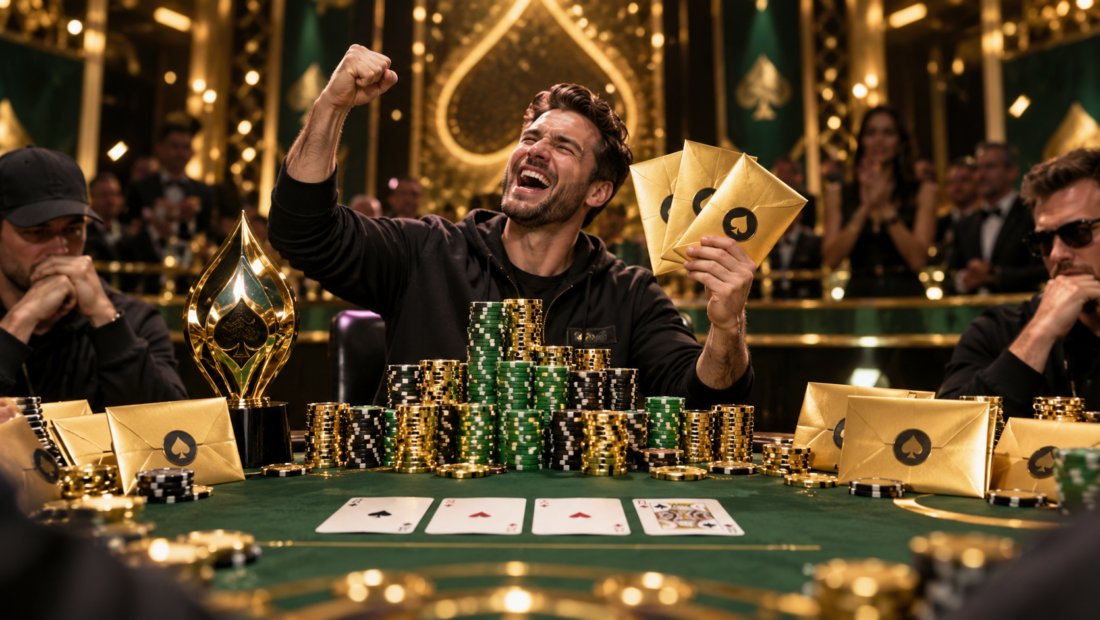
Aaron Pinson did more than win the $2,200 Big, Big Borgata Mystery Bounty at Borgata in Atlantic City. He also collected all three of the largest bounty prizes available during the event. The tournament drew 232 entries and carried a $500,000 guarantee. By the end, Pinson had secured $44,825 from the regular prize pool and $155,000 in mystery bounties for a total return of $199,825.
Pinson wins the title and dominates the bounty pool
That represented roughly 40% of the overall prize pool attached to the event. The unusual part is not simply that the champion also did well in the bounty phase. Pinson found both $50,000 top prizes and then, after reaching heads-up against Matt Glantz, drew the final $25,000 bounty as well. Mystery Bounty events are designed to separate knockout value from finishing position, but in this case the two paths converged almost perfectly for one player.
The bounty phase begins with 24 players left
Day 2 started with 24 players remaining, all of them already in the money. That was also the point at which the mystery bounty phase began. The field knew there were two $50,000 prizes in the bounty pool and none larger. Pinson immediately changed the tournament when he became the first player to eliminate an opponent on Day 2. He went to make his first draw and hit one of the $50,000 bounties despite having only a one-in-twelve chance at that moment. The size of the prize meant he had already won as much from a single envelope as the scheduled first-place cash payout was worth. In many tournaments, that would have been the defining moment of the day. For Pinson, it became only the first major bounty in a sequence that kept getting less likely as the event moved toward the final table.
More bounties arrive as the stack grows
Pinson continued building chips while also adding to his bounty total. The source notes a $10,000 draw among the additional prizes he collected. Then he found the second $50,000 bounty, meaning both top denominations in the entire event had gone to the same player. By that point, the bounty side of the tournament had become almost as important as the conventional prize ladder. Mystery Bounty structures create exactly that possibility. A player does not know the value of a knockout until the draw is made, so two eliminations with similar poker value can produce radically different financial outcomes. Pinson’s run sat at the extreme end of that variance. He was progressing deep enough to remain in contention for the title while repeatedly selecting the most valuable prizes available. The combination created a payout profile that a standard no-limit hold’em event could not reproduce.
Heads-up brings Pinson and Glantz together
The final opponent was Matt Glantz, a player with his own memorable history in mystery bounty poker after pulling the $1 million bounty at the 2023 WSOP. By the time the pair reached heads-up at Borgata, their stacks were nearly identical. Rather than continue playing the regular prize portion, they agreed to an even chop that gave each player $44,825. That deal separated the remaining questions into two smaller contests: who would receive the trophy and who would draw which remaining bounty. The players decided to flip for the trophy. Pinson won the flip and became the official champion. The bounty draw still remained, and that was where the day’s extraordinary pattern repeated itself. After already collecting both $50,000 prizes, Pinson had one final draw to make.
The final draw produces another major prize
Pinson’s last envelope contained $25,000, the second-largest denomination that could still be available at that point. Because only two bounty values remained for the heads-up players, the result also told Glantz what his own final bounty was worth: $10,000. The draw pushed Pinson’s bounty total to $155,000. Combined with the $44,825 share of the chopped prize pool, his event total reached $199,825. The amount is striking because the event itself carried a $500,000 guarantee. One player therefore left with close to two-fifths of that headline figure. The source describes this as “just about” winning the whole prize pool with obvious exaggeration, but the underlying point is valid. The mystery bounty mechanism concentrated an unusually large amount of the available value in a single player’s run, despite the regular tournament payout being split at heads-up.
Why the format can produce results like this
A conventional tournament ties most of a player’s payout to finishing position. Mystery Bounty events split the reward into two components. One comes from surviving and moving up the normal prize ladder. The other comes from eliminating players after the bounty phase begins and then drawing an unknown prize. That means a player can finish below first and still outperform the champion financially, or a champion can do what Pinson did and capture both sides of the structure. The bounty pool in this event contained $250,000 in total. Pinson had accumulated $130,000 of it before the final heads-up draw. His last $25,000 envelope lifted that figure to $155,000. The result illustrates the core appeal and volatility of the format without needing any extra assumptions: the poker determines who earns the right to draw, but the value of each draw remains uncertain until the bounty is revealed.
Pinson entered with an established live record
The win also adds to an already substantial live tournament record. The source credits Pinson with more than $2.4 million in recorded Hendon Mob cashes before this result. That background matters because the day can look almost impossibly lucky when reduced to the bounty sequence alone. Pinson still had to navigate a 232-entry no-limit hold’em tournament, survive into Day 2, build a stack and reach heads-up before the final draws could happen. The bounties magnified the financial outcome, but they did not remove the underlying tournament progression. His chip accumulation is what created repeated opportunities to eliminate players and access the bounty drum. The result is therefore best understood as a combination of deep tournament play and exceptionally favourable bounty variance rather than one replacing the other.
The Glantz connection gives the ending extra symmetry
Glantz’s presence at heads-up made the final bounty draw especially memorable because he is strongly associated with one of the largest mystery bounty pulls in live poker. At the 2023 WSOP, he drew a $1 million prize. In Atlantic City, however, the bounty luck went the other direction. Even though the two players reached heads-up with similar stacks and split the regular prize money evenly, Pinson won the trophy flip and then selected the $25,000 envelope. Glantz was left with the $10,000 bounty by process of elimination. The contrast is a reminder of how little prior history matters once the mystery draw begins. Reputation, experience and stack size can determine whether a player reaches the bounty stage, but they cannot control which sealed prize is attached to the next draw.
A $199,825 day from a $2,200 event
The final accounting shows why the tournament attracted attention. Pinson’s regular tournament payout was $44,825 after the heads-up chop. His mystery bounties added $155,000. Together they produced $199,825 from an event with a $2,200 buy-in. The headline figure should still be read in the context of a tournament with 232 entrants and a high-variance bounty structure, not as a normal return associated with the buy-in. What makes the result newsworthy is precisely that it is abnormal. Both $50,000 prizes went to the same player, and that player then found the larger of the two remaining heads-up bounties as well. The result compressed a large share of the event’s financial value into one run in a way that ordinary payout ladders rarely allow.
The champion story is inseparable from the envelopes
Pinson leaves the Big, Big Borgata Mystery Bounty with the trophy, the official title and a total payout just short of $200,000. Any one of those pieces could have made the event a successful stop for him. Together, and especially with all three top mystery bounties included, they created a result that will be remembered more for the distribution of the prize pool than for the final heads-up hand. The tournament itself still required the usual ingredients of no-limit hold’em survival: managing a stack, winning key pots and reaching the final stage. But the bounty format added a second layer of uncertainty that repeatedly broke in Pinson’s favour. The two $50,000 envelopes and the final $25,000 draw turned a chopped first-place payout into a much larger overall win. In a format designed around unknown prizes, one player managed to find almost every envelope that mattered most.
Why this result is difficult to repeat even for a strong player
The numbers make Pinson’s run look almost inevitable in retrospect, but the structure shows how unusual it really was. He first had to earn repeated bounty draws by eliminating opponents after the mystery phase began. He then had to select both of the two $50,000 prizes from a pool that still contained many smaller values. Finally, after the heads-up chop and trophy flip, his last draw produced the $25,000 bounty instead of the remaining $10,000 prize. None of those events changes the value of the poker decisions that brought him deep into the tournament, but the bounty sequence itself depended on outcomes he could not control once the envelopes were available. That is why the $199,825 total should be treated as a standout result rather than a normal expectation for the format. Pinson’s established live record explains how he reached the position to keep drawing, while the envelopes explain why this particular victory became so much larger financially than the ordinary first-place payout.